Showing posts with label Energy. Show all posts

Saturday, May 29, 2010

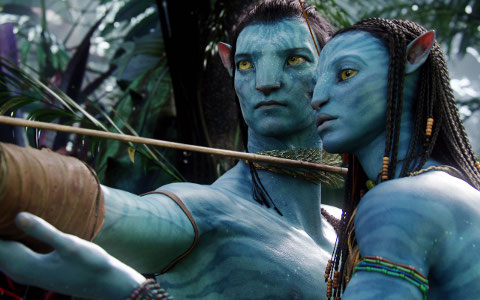
Thoughts on Avatar: Close, But Still a Swing and a Miss


Hi Everyone,

Well, today I will talk about movies again. This time, Avatar is the subject. Avatar, you may remember, was released last December with much pomp and fanfare. Much was made of its visual appeal. The film cost $250 million to make, and took four years to make (planning and development began as early as 1994). When it was released, it broke several records at the box office and was a gigantic commercial success.
I didn't necessarily want to see it in theaters, since anything which is so widely hyped tends to draw my skepticism. However, I have been eager to see it for quite some time. I heard that it promoted the sanctity of native cultures, the importance of a connection to the natural environment, and the transcendant connection of all forms of life. I also enjoy movies that involve travel to distant planets. So the prospect of a sci-fi space movie that expressed a "new age-y" message of harmony seemed like it would be right up my alley.
I got to start watching it yesterday night, friday night, on netflix. The movie is 2 hours and 42 minutes long, so my family and I watched half of it last night, and will watch the other half tonight. So here I will talk about my impression so far.
The film follows Jake Sully, a marine who is hired by a private security force working for a large mining company. The company has hired him to protect a plant they operate on Pandora, a moon in the Alpha Centauri system, much like Earth. Jake lacks the knowledge most scientists on Pandora, but possesses an iron will to overcome his troubles moving. The film implies that the Earth has been ridden with wars in the time between now and the film's future setting; since it is set in the year 2154.
Anyway, Jake is put in an avatar, the body of a na'vi, a creature who lives on Pandora. Jake controls the body of his avatar with his mind somehow. Anyway, he wanders deep into the Pandoran forest, tangles with various forms of wildlife, and meets a female of the na'vi tribe. She resents him at first, but takes him to her village. They decide, again, with considerable reluctance, to take Jake in. This is about where we left off, when Jake is learning the ways of the na'vi. In one scene on the floating mountains, the Hallelujah Mountains, they are, quite literally, showing Jake the ropes.
So far, my feelings about the movie are about what I thought they would be. I like it overall, but I do have some issues with it. First off, I find this much more believeable and identifiable than
Star Wars was. Again, this one touched on concerns much more important to me. This energy industry embodies the current corporate model of the profit above all. As the head of the industry says "The one thing the bosses hate more than bad press is a bad bottom line." I think it is a good thing that this is being brought up in a movie with as much critical and commercial success as Avatar.
That leads to my next point. It seemed that this had at least as much to do with special effects as its perceived message. There were several scenes where the na'vi talked about the connections to all life forms and the world of nature itself. The way this was presented, though, is often second behind the visual graphics and effects, which are amazing. Knowing that this is also James Cameron's creation, who also did Terminator and Titanic, it isn't a surprise that the visual appeal would be a top priority for him. However, I feel disappointed in that the film seems to be sacrificing an opportunity to reexamine life, in order to wow everyone with uber-cool special effects and rake in a fortune at the box office.
I have only seen half the film so far, though. I have heard that the end of the film consists of a grand battle between the na'vi and the humans. Again, this smacks of a concession to the formula of Hollywood. Rather than trying something different, the film seems to be reconstructing a well-worn equation with the newest graphics. That is their decision, but this is my decision to weigh in on this. But again, I have only seen part of this. I will report back here when I have seen the whole thing. See ya then!
This is the Daily Reeder, Over&out.

Tuesday, January 6, 2009

Most Underrated President?: In defense of Jimmy Carter

Hello Everyone,

I've decided to try a new sign-in line. I'll probably alternate between several, using whichever one I feel like on that given day.

Anyway, I'd like to take this opportunity today to pay tribute to a man who worked very hard, but never gets any credit for everything he did. In spite of many achievements, this man has been turned into a laughingstock (is that all one word?). Well, I'm going to take this time to stand up for this man who is too often ridiculed or brushed aside. I'm writing this about the 39th President of the United States, Jimmy Carter.

Earlier today, I came across a similar piece written on Carter by a good, christian journalist. If you're too lazy to follow the links I put up (I don't blame you!), I'll summarize some of the things the article says. I also have a link to the world's greatest research site which I'll also summarize.

When he signed the treaty giving the Panama Canal back to Panama, he was met with intense ire by the republicans. However, looking at what has been done since, this was a wise move, considering that advisers thought retaining the Canal would ensure a costly war. He authorized the SALT (Strategic Arms Limitation Talks) II treaty in 1979, which drew down numbers of missiles in both the US and the Soviet Union. Again, this was criticized because it was thought to weaken the nation's defenses.

On the human rights front, Carter was simething of a pioneer. He distanced himself from the policy of containment, which all previous presidents had employed. The policy involved supporting pro-US leaders, even if they were dictators who abused their people, to curtail communist influence in poor nations. Carter ended support for despots like Anastasio Somoza in Nicaragua, Alfredo Stroessner in Paraguay and Chile's infamous Augusto Pinochet. He was critical of South Africa's Apartheid regime. He wasn't successful in promoting human rights in every instance, but on the whole, his record on this is phenomenal compared to most other presidents. This is to say nothing of the Camp David Accords and progress toward a peace between Israel and the Arab world, an issue which plagues us to this day.

However, Carter realized that the Soviet Union was a threatening entity. So while he signed the SALT II treaty and cut back on defense spending, he also authorized stealth bomber technology and authorized new technology for the missiles that were developed. It was under Carter's watch that US support for the mujahideen fighters began. Carter, along with National Security Advisor Zbigniew Brzezinski (wanna try and pronounce this name?), began sending finances and training to the islamist mujahideens in 1979. Carter also set up the Rapid Deployment Forces, the predecessor to CENTCOM. In many ways, Carter was just as much a hawk as he was a human rights-nik.

When it came to the environment, Carter was definitely a pioneer. He was "green" even before there was such a thing as being "green" (and long before he saw Inconvenient Truth!). He emphasized conservation and efficiency. It was in 1977 that the Department of Energy was created to reach these ends. He even decreed that hot water be turned off in some federal facilities. He had a wood stove in the living quarters and ahd solar panels put on the roof of the White House. Under his watch, the National Renewable Energy Lab was created here in Golden, Colorado, which is still functioning to this day, and which employed my grandfather from 1977 to 1985. Many of the ideas that were dismissed back then are now taken seriously as environmental common sense, making him the first environmental president.

There were, of course, things he didn't do so well on, like the economy, the whole thing with inflation. As the article points out, the inflation was due in large part to OPEC's control of the oil prices. And, though he did screw up on some policies, as FDR said,"Better the occasional faults of a government working out of a spirit of charity, than the constant ommission" of a government working only for the well off at the expense of everyone else. Some of his successors sought to cut programs by the government, while forgetting one thing, people need the government. In spite of all the talk of self-reliance, which I support, btw, people can't do everything themselves. Government fills a need, but this is a whole other post.

Anyway, there was the whole "malaise" speech (in which the word "malaise" was never used). Carter pointed out that the nation had replaced the traditional belief in God with a belief in unbridled material consumption. The speech goes as follows:

"I want to talk to you right now about a fundamental threat to American democracy... I do not refer to the outward strength of America, a nation that is at peace tonight everywhere in the world, with unmatched economic power and military might...
The threat is nearly invisible in ordinary ways. It is a crisis of confidence. It is a crisis that strikes at the very heart and soul and spirit of our national will. We can see this crisis in the growing doubt about the meaning of our own lives and in the loss of a unity of purpose for our nation.
In a nation that was proud of hard work, strong families, close-knit communities, and our faith in God, too many of us now tend to worship self-indulgence and consumption. Human identity is no longer defined by what one does, but by what one owns. But we've discovered that owning things and consuming things does not satisfy our longing for meaning.
I'm asking you for your good and for your nation's security to take no unnecessary trips, to use carpools or public transportation whenever you can, to park your car one extra day per week, to obey the speed limit, and to set your thermostats to save fuel... I have seen the strength of America in the inexhaustible resources of our people. In the days to come, let us renew that strength in the struggle for an energy-secure nation."

Later, the speech was said to have "struck a responsive chord" with the American public. Few public figures since have made pronouncements like this. It seems like this man had lots of insight.

So, what cost Jimmy Carter politically? Mostly, it was his willingness to make unpopular Lots of people talk a big game about making unpopular decisions, but when President Carter actually did it, opponents turned him into a mockery. For his actions, Carter took just as much flack from democrats as republicans. Many democrats didn't like the peanut farmer from the deep south, who by the way, was devoutly christian.

Since his presidency ended in 1981, Carter has been working tirelessly for the good of the least among us. He held summits in Africa in the 90's. He has worked on the ground in Israel and Palestine for "Peace, not Apartheid". He, along with his wife, Rosalynn, have worked with Habitat for Humanity, helping build homes for the poor to be able to own. In 2002, his humanitarian work even won him the Nobel Peace Prize. So, while Jimmy Carter may not have been the greatest president, he may just be the most underrated. So, Mr. Carter, the Daily Reeder salutes you.

This is the Daily Reeder, Over&out.

Monday, December 29, 2008

The Brooklyn Project:Red, White, Blue, and Green?

To one&all,

Well, I was reading the Christian Science Monitor today, and I came across this article which I felt I must blog on. The article was talking about a wind energy initiative in Montana. Apparently, there's a lot of wind on the praries up there (if anyone reading this is representin Montana, I encourage you to respond and fill me in on this if you can). The current number of wind turbines (most of which are concentrated on a single wind farm near the town of Judith Gap, MT, 100 miles east of Helena) is said by the monitor to provide 7 percent of the state's electricity needs. Similar farms are being developed across the state.

In other states, including here in Colorado, there have been similar initiatives. As I tool around here, I've noticed a lot more collections of solar panels than when I was here last. Even back in my home of California, they have led an effort to set an example on environmental policy.

More on the green front, some companies are now designing smaller nuclear reactors to generate power, again, in an article from the Christian Science Monitor. Apparently, two energy companies, one in New Mexico and another in Oregon, have looked into designing nuclear reactors that are small enough to be easily shipped from place to place and would only have to be changed every several years. The small town of Galena, Alaska is already looking to have one such reactor installed to power their homes by 2012.

So, how does the Daily Reeder feel about these efforts? I personally applaud the efforts of the Governors and others working within the states of Montana, Colorado, California, and many others not named here. Of course, there are some flaws in the plans that have been enacted so far. For instance, with the wind farms, there is concern over transmission, the conversion, I suppose, of wind energy into electricity. And with nuclear power, there is of course the concern of sabotage, the reactor letting out toxic radiation.

However, I believe that energy and environment will be our next frontier of innovation. Back in the '60's a young, up-and-coming leader pledged that by the end of that decade, we would put a man on the moon. Low and behold, one giant leap for mankind unfolded in 1969. In 1933, our nation was in the depths of another economic catastrophe. The president then launched a series of projects and created a common safety net. Later, when others turned to fascism, all pitched in to ensure that that toxic system of thought was driven away.

Alright. alright, I don't mean to get all preachy here. But it seems that this is another on which we (in America and across the world) can demonstrate something about humanity. It seems like we need something like a new Manhattan Project, except this time, instead of developing means of destruction, this project will develop means of rejuvenation. Call it the "Brooklyn Project", or the "Queens Project" or any other borough of New York City you choose:). In fact, President-Elect Obama's ambitious slate of plans includes a plan to create 5 million new jobs by catalyzing efforts to develop clean, renewable energy sources over the next several years.

Now, challenges of course, will arise with this new endeavor. And none of these things working alone can address this call to action. If you'll look at the bottom of the first article, you'll notice one of the comments "the better solution is to limit the need for power by conservation and restricting immigration". It see,s to this blogger that conservation can also help out, but I also think it should work in tandem with efficiency and looking for better fuels. As for immigration, that is a blog post unto itself.

This will not be an easy task. But none of the great deeds of history has ever been easy. None of the things I mentioned above were easy. This will probably be one of the greatest challenges of this (my) generation. But, if the public can pull together, with indivduals like Obama, the Montana governor, Brian Schweitzer, who is calling for federal money to help reinvigorate the power grid within that state and in other places, and others enlisting innovation, I have some confidence in the future. If we can pull this off, this will say a lot about us, both as Americans and as human beings.

This is the Daily Reeder, Over&out.